
Interview by Shane Record
|
Taking seven years to plan and seven days to put into place, the horse on the hill embodies a story of resourcefulness, determination and teamwork. After all, how do you get a 100 metre horse onto a near-vertical hill with no budget, and enough red tape to wrap up a building? Creator of the horse on the hill, Charlie Newington of Lympne, met Shane Record to elaborate....
SR: When did you get the idea to do it?
CN: I started to have a think about a project that could be done to mark the millennium about seven years ago. The idea of doing an enormous hill figure seemed great.
SR: What was your plan?
CN: I originally wanted to do it on Summer House Hill, but although the MOD (who owns the hill) liked the idea, they put it forward to a committee of conservationists who rejected it.
SR: So what did you do then?
CN: My partner in this project, Richard Beaugie contacted a friend of his - Paul Tory - who owns the Etchinghill Escarpment. Paul then agreed to let me use the site. But opposition didn't end there. English Nature had previously designated the site 'of scientific interest,' which led to two years of talks to sort it out.
SR: What were their objections?
CN: Basically, rare spider orchids, butterflies and increased visitor pressure. But these objections didn't seem applicable - the chalk from the horse was going to attract and help buterflies and part of the land use agreement was to have cattle roaming on the land. So that was when we decided to fight it and not walk away.
SR: I take it official objections didn't end there?
CN: No! We had objections from all over the place but were determined to counter them. If your ideas don't fit neatly into the right forms and boxes you meet opposition. I've spent 95% of my time with bureaucracy, and 5% out on the hill! But we did have some support, too. Michael Howard, Spike Milligan, even the local council. Our next battle is with the EU. But we'll have to see what happens.
SR: Is this the first project of its kind you've ever done?
CN: Yes.
SR: Where did the image of the horse come from?
CN: I suppose the idea of the horse came from the Uffington Horse (in Oxfordshire), but its style was inspired by something else. I'm fascinated by the Palaeolithic cave paintings of beasts that I've seen in South West France. It's known as primal animist imagery - simplified imagery that is a mixture of animals, magic and spirituality. I tried to capture a little bit of the magic I felt myself.
SR: Were you always going to do a horse?
CN: I had intended nine images on my plan for Summer House Hill, with a bull, a stag and horses, all running in one direction. It was a little over-ambitious. Then I reduced the number of figures to three. And then to one. Then once this site came up everything seemed to fall into place. It's a beautiful site, a fabulous canvas. The name of the escarpment (Etchinghill) comes from the Old Celtic word 'each' which means horse. There is a romantic suggestion that there had been a horse on the hill there before. A little far fetched, but nevertheless feasible. Also, it was 'correctly' aligned with the former iron age camp on Castle Hill.
SR: Did you struggle with the design?
CN: Only in overcoming the sculptural problems. The horse had to look good from all angles. It's squat from the far west, and long when you're alongside it. If you're on the train or driving, it looks curiously as if it's legs are moving.
SR: I heard you had a dowser here?
CN: Yes. The land's natural energy was central to the project. It wasn't the very early idea but soon became part of it. As all the early giant figures and all the major landmarks of architecture (Stonehenge, Canterbury Cathedral) were placed on the natural positive energy lines, aligning the figure in this way felt the right thing to do.
SR: How many people got involved with the project?
CN: Hundreds in one way or another. Because the budget was, well, shoestring, the whole thing has been done on the goodwill of those getting involved. Christiaan Zwart, a London barrister, did everything for nothing, as did the Gurkhas who laid the stones. The Tory Family Trust paid for all the materials at no benefit to them. And then there are all the others; a local chap walked past with his dog and asked us what we were doing. He then spent the next three days working like a trooper helping us! Roy, a local retired lorry driver, was watching the news on telly and saw the Gurkhas carrying the slabs over their heads. He then left his armchair for his workshop and built a series of amazing contraptions on skis to get the stones into place.
SR: Have you found the response to be good?
CN: Absolutely. Of course, once in a blue moon you come across people who don't like it. But now even Eurotunnel are offering to help protect it.
SR: Have you had problems with vandals then?
CN: A bit. They'll come up here with their hammers and try to smash it, but the horse will stay. The idea is for it to last until the next millennium or three. If other hill figures can endure, why can't this one?
SR: Would you do a project like this again?
CN: Yes. But only if I was commissioned. I'm no good at getting grants and all that. The project didn't cost the taxpayer a penny. But it cost me a fortune in paintings - for gifts and bribes!
I would like to say Thank you to Shane Record for allowing us to read his interview with Charles Newington. I would also like to thank Charles for having the idea in the first place, and for having the persistence to see it through to the end! It is a wonderful piece of art, and I for one would like to see more of them on other hills.
Also, thank you to the Gurkhas and everyone else who had a hand in making it a reality. You did a fabulous job!
I only wish it wasn't so difficult to find a place to photograph it from. I finally managed to get the one at the top of the page by going up to Shorncliffe Camp, and even then, it was so far away, I had to scan the photograph with enormous resolution to be able to produce it as well as you see above. (I don't have a very sophisticated camera!)
Taken from The Quarter Magazine
|

Charles Newington
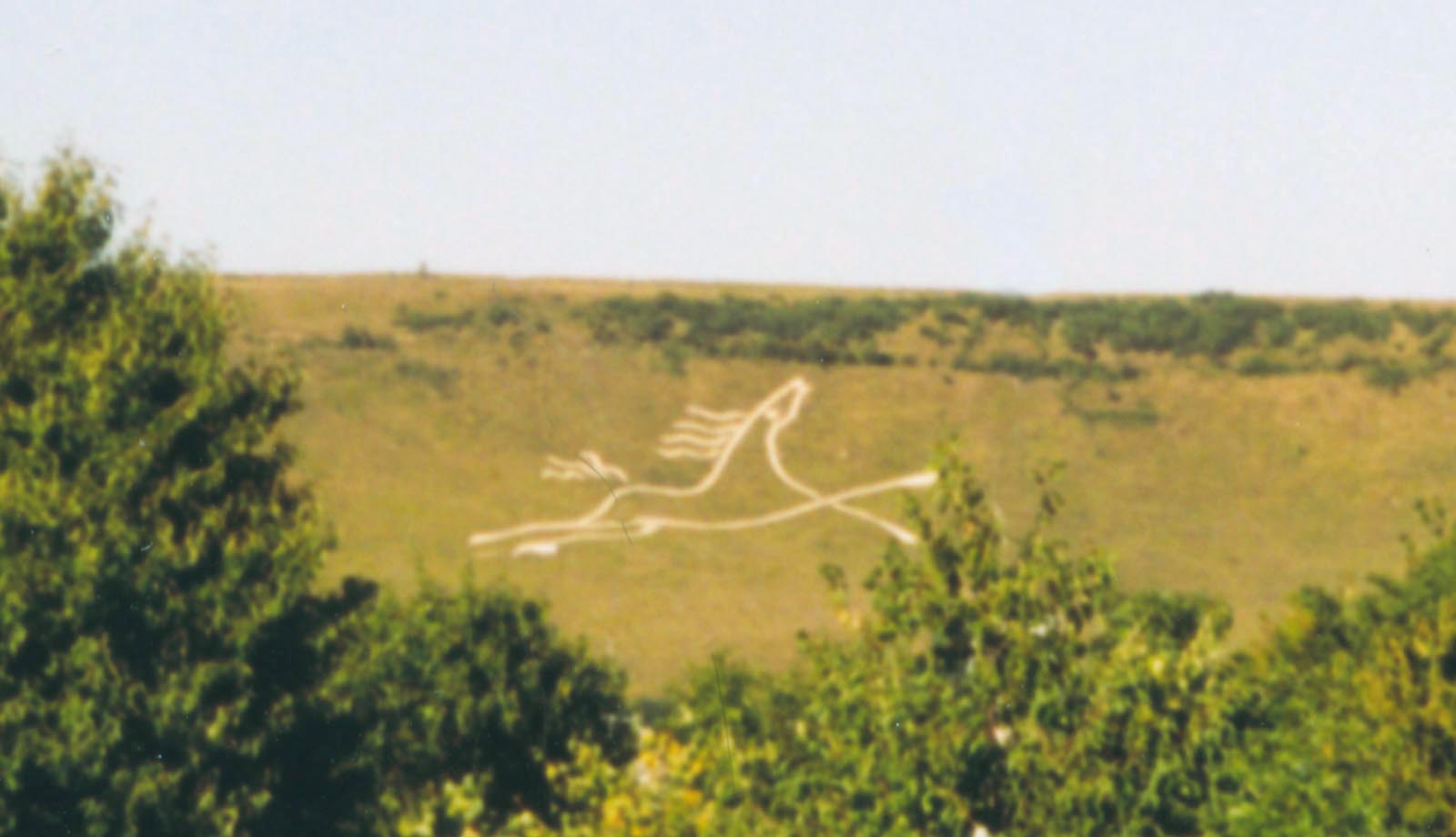
Photo taken by Shane Record


