
ANOTHER ATTRACTION FOR FOLKESTONE
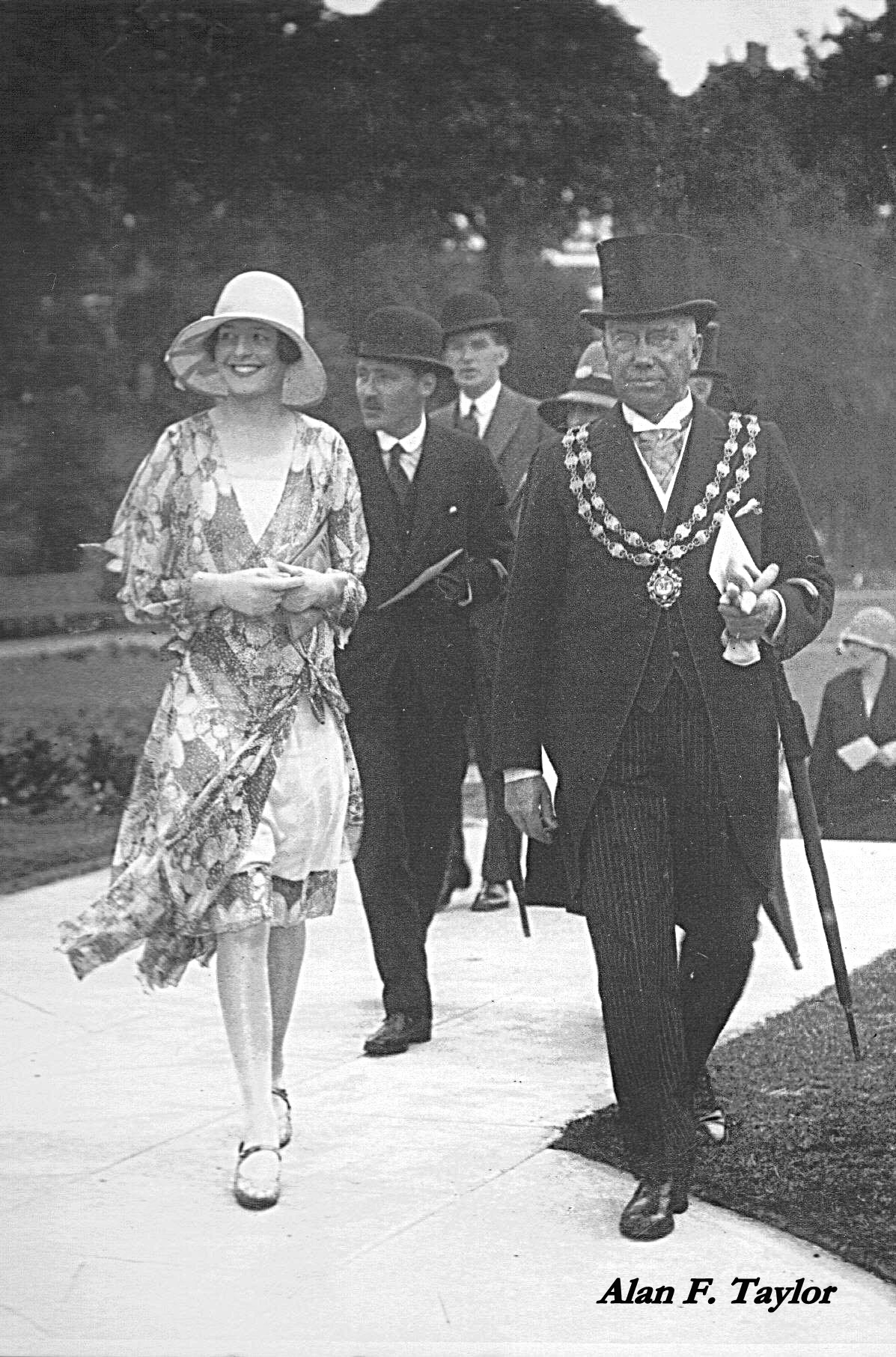
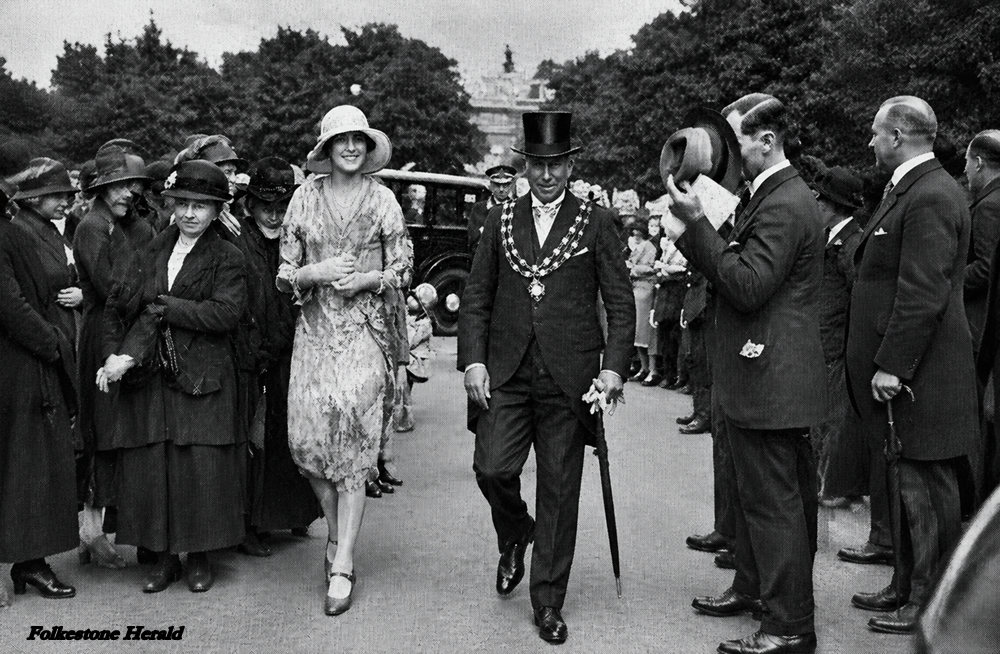
Viscountess Folkestone on Wednesday afternoon declared open Kingsnorth Gardens, the latest addition to Folkestone’s amenities and one that has met with the approval and praise of all townspeople. Viscount Folkestone, who gave the land to the Corporation accompanied his wife.
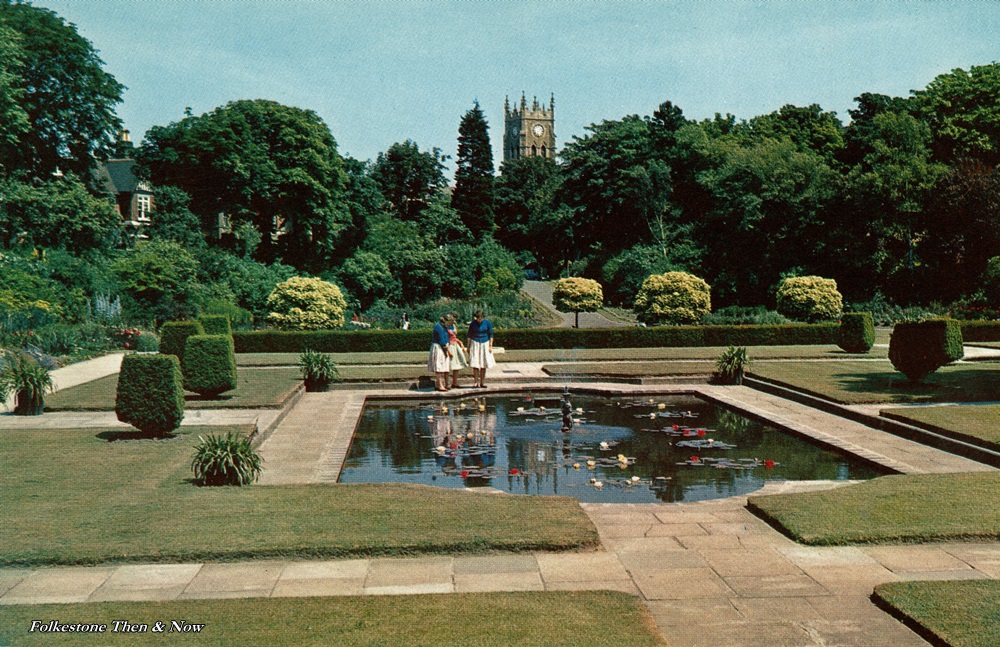
In place of what was once a mass of overgrown weeds, a few cultivated allotments, a wonder garden has been laid out, beautiful in its simplicity and artistry, a little jewel in a delightful setting, reposeful, sheltered.
Viscount and Viscountess Folkestone were received by the Mayor and Mayoress (Alderman R. G. Wood, J.P., and Mrs. Wood), and the Town Clerk (Mr. C. F. Nicholson). Her ladyship looked charming in a light frock and picture hat.
Those who accepted invitations to be present included:—
Colonel and Mrs. A. Atkinson, Mr. and Mrs. W. Ambler, Mr. and Mrs. Spencer Apps, Mrs. and Miss Allatt, Mr. and Mrs. W. Allsworth, Mr. Ashton-Allen, Councillor Mrs. M. I. Anness.
Councillor and Mrs. Dallas Brett, Mr. and Mrs. J. Bull, Councillor and Mrs. C. Bell, Mr. and Mrs. A. S. Beesley, Mr. and Mrs. J. H. Blamey, Mr. and Mrs. W. R. Boughton, Mr. and Mrs. Boulton, Mr. and Mrs. H. Bobby, Mr. and Mrs. J. Baker, Mr. and Mrs. W. B. Banks, Mr. and Mrs. G. C. Bond.
Councillor, Mrs. and Miss Castle, Mr. and Mrs. L. G. A. Collins, the Rev. Dr. and Mrs. J. C. Carlile, Dr. and Mrs. J. E. G. Calverley, Mr., Mrs. and Miss Chapman, Major and Mrs. Compton, Mr. and Mrs. T. C. Cullum, Mr. and Mrs. J. Cobb, Mr. and Mrs. A. J. Crowhurst.
M. Leon Datte, the Rev. and Mrs. C. A. Darby, Mr., Mrs. and Miss de Pass, the Misses de la Mare.
Mr. and Mrs. J. F. Eldridge, Mr. and Mrs. F. D. Erith, Mr. and Mrs. A. J. English, Alderman and Mrs. T. S. Franks, Mr. G. Farrar, Mr. and Mrs. F. E. Fletcher, Mr. and Mrs. E. Fullager, Mr. and Mrs. H. Franklin.
Dr. A. J. Gore, Councillor Mrs. E. Gore, J.P. and Miss Gore, Councillor and Mrs. G. A. Gurr, Colonel P. Broome Giles, J.P., Mr. and Mrs. W. Griffin, Miss Griffin, Mr. and Mrs. P. Greenstreet.
Mr. and Mrs. G. A. Hills, Councillor J. Hanchard, Mr. and Mrs. Howlett, Alderman F. Hall, J.P., Miss A. M. Hunt, J.P., Mr. and Mrs. S. Hall, Mr. and Mrs. F. T. Hall, Mr. and Mrs. C. Hall, Mr. P. J. Hall, Mr. and Mrs. T. Hulme, the Hon. Mrs. Howard, Mr. and Mrs. Hickinbotham.
Mr. and Mrs. P. D. Igglesden, the Rev. J. W. Inglis.
Mr. and Mrs. F. Joseph, Mr. and Mrs. C. Jenner, Mr. Jeffery, the Misses Jeffery, Mr. and Mrs. P. Jacklin, Mrs. Jenner, and Mrs. Box.
Councillor Colonel H. T. and Mrs. Kenny, Councillor and Mrs. W. J. King-Turner, Madame Kirby, Miss Starkey, Mr. and Mrs. G. W. Kemp.
Dr. and Mrs. P. G. Lewis, Miss Lewis and Mr. J. H. Lepper.
Alderman and Mrs. M. Moncrieff, Mr. and Mrs. E. T. Morrison, Mr. and Mrs. O. Marx.
Mr. and Mrs. E. Newman, Mr. and Mrs. C. F. Nicholson, Mr. and Mrs. A. E. Nichols.
Alderman and Mrs. A. E. Pepper, Miss Q. S. J. Penfold, Miss M. Penfold, Mr. and Mrs. E. C. Potter, Mr. and Mrs. C. Pilcher, Mr. and Mrs. W. H. Routley, Mr. and Mrs. G. E. Roden, Cav. Uff. and Mrs. Ronco, Mr. and Mrs. H. A. E. Roberts, Captain and Mrs. R. W. Reed, Sir Herbert and Lady Raitt, Sir William and Lady Rees-Davies, Lady Raphael, Mrs. Roberts, Councillor and Mrs. N. W. Raw.
Mr. and Mrs. G. I. Swoffer, Councillor Colonel and Mrs. W. Swinhoe-Phelan, Alderman and Mrs. G. Spurgen, the Misses Spurgen, Councillor and Mrs. R. L. T. Saunders, Mr. and Miss A. Stace, Mr. and Mrs. W. Smith, Mr. F. Seager, Mr. and Mrs. W. Standring, Mr. and Mrs. C. Sheath, Captain and Mrs. St. Clair, Colonel F. St. D. Skinner, Mrs. Skinner, Miss Fergusson, Mrs. Standen and Mrs. Sherbrooke.
Councillor and Mrs. H. C. Turnham, Mr. and Mrs. G. T. Tayler, Mrs. Tolputt, Councillor and Mrs. A. H. Ulyett.
Mr. and Mrs. H. W. Watts, Dr. F. Wolversen, J.P., Mrs. Wolverson, Miss Wolverson, Mr. and Mrs. G. C. Walton, Mr. and Mrs. R. Williams, Mr. and Mrs. G. Walker, Mr. and Mrs. F. E. Waite, Mr. and Mrs. C. H. Wodeman, Mr. and Mrs. C. J. F. Whewell.
Dr. M. G. Yunge-Bateman and Councillor Major-General and Mrs. L. N. Younghusband.
Viscountess Folkestone was presented with a beautiful bouquet of roses and carnations by Master Brian Roden, son of the Parks Superintendent (Mr. G. E. Roden) who is responsible for laying out the gardens.
The Mayor, in asking Viscountess Folkestone to declare the gardens open, said his was a very pleasing duty that afternoon, and he was sure they would agree with him when he said that the first words he thought he should utter were words of welcome to Lord and Lady Folkestone for taking the trouble to come there that afternoon (hear, hear). They were delighted to see them. They knew that they were both very busy people: Lord Folkestone had many interests, particularly in regard to agriculture, and he also knew that Lady Folkestone was a very busy woman. But despite that they had found time to come up from Salisbury in order that Lady Folkestone should honour them by declaring those gardens open to the public.
They felt that they could not do less than send an invitation to them both to come. They had complied with that invitation and everyone of them present that afternoon was delighted to have the Lord of the Manor and Lady Folkestone in their midst to carry out that small but very pleasing duty (hear, hear).
There were a great many things one might say that afternoon. He might say it was very gratifying to everyone of them that the wind had dropped, the sun had come out, and the rain which threatened earlier had passed over, and the sun had come out for that ceremony (hear, hear).
INDEBTED TO RADNOR FAMILY.
Coming back to the gardens, they were indebted once again to the Radnor family and Lord Folkestone in particular for the magnificent gift which they made to Folkestone in giving them that land there in the centre of the town to be used for municipal purposes (applause). The land was not altogether given for the purposes of a pleasure ground; in fact he understood the ground must not be used for sport; but they were not prevented from using the ground for the purpose of gardens. If it had been given to them so that it should be used for municipal purposes. Some day it might be the site of the town’s new town hall; they were not debarred from using the ground for that purpose, but he would make no effort to pull up those beautiful flowers and put a building in the gardens. He knew how much those living in the vicinity of the Gardens appreciated what had been done.
In asking the Council to lay out the ground when he took the chair in 1926, he put forward several arguments, but there was one he did not put forward and one which he did not think of at the time. A gentleman had told him how many of them to-day were forced to live in flats. They no longer were able to enjoy and have their own gardens. Living in flats meant living without a garden. Those gardens, however, would give those flat dwellers a beautiful place in which they could come and sit and admire as if it were their own. That was a feature which the Council did not think of at the time, he was sure.
The Gardens had not been laid out regardless of cost; the work had been done at the minimum cost. In December 1926, they had a lot of unemployed and the Council decided to start the work straight away notwithstanding what use the ground might be put to at some future date. The Parks Superintendent prepared a plan, got out the cost, and that plan was approved by the Parks Committee and confirmed by the Council. He was also told that he would have to use unemployed labour, so many men from the Guardians, and so many from the Labour Exchange, and the result was that the work that had been carried out there had been done by unemployed men. They offered work to men who were out of work; they had studied economy; and most of the money had been spent on labour and had gone into the pockets of men who otherwise would have been out of work (hear, hear).
THE FIRST GIFT.
They were indebted, as they knew, to the Radnor Estate for many of the amenities which they enjoyed in Folkestone. He had gone back as far as Lord Folkestone’s grandfather, the fourth Earl of Radnor. He made the first gift, so far as he could find out, in the way of a public pleasure ground. Of course other pleasure grounds had been laid out by the Lords of the Manor such as West-cliff-gardens, Augusta-gardens, etc., but they were intended for the use of residents whose houses adjoined those gardens.
The fourth Earl of Radnor kindly gave them the land for Radnor Park, land consisting of 21 acres. In 1885, pleasure grounds and recreation grounds were not valued like they were to-day, and the Corporation, he was told, looked askance at the offer because a condition was that the town should lay out the ground. When told how much it would cost, they wondered whether they should accept the gift or not. They were not guilty of anything like that to-day (laughter).
The fifth Earl of Radnor gave them the Marine Gardens in 1892, about two acres of land and the present Lord Radnor had given them the beautiful Leas and Undercliff (applause), a gift which had insured that the Undercliff should never be built upon. He had also given them the land for the Canterbury-road recreation ground; and in 1920 he gave them the East Cliff and Warren, which consisted of about 230 acres (applause).
Then, both Lord and Lady Folkestone gave to the town the land in Kingsnorth-gardens. He went a step further, too, last year when he gave them ten acres of land in Cherry Garden-avenue for a pleasure ground for Morehall (applause). Those Gardens had been laid out not for children but adolescents and adults who wished to come there and enjoy the flowers and blooms.
The gift Lord Folkestone had given them last year in Cherry Garden-avenue had made it possible for them to invite the Kent County Agricultural Show for 1928 to be held at Folkestone. Lord Folkestone had also agreed to be President of the Show, and he believed Viscount and Viscountess Folkestone would spend a week at Folkestone during the Show (applause). They did appreciate all that the Lord of the Folkestone Manor had done for them as a town during the years that had passed (applause), and he had great pleasure in once again offering them a very hearty welcome. They appreciated the gift of that land to the town and he hoped they were pleased with the way in which the land had been laid out. In the years to come the gardens would be even more beautiful than they were that day (applause).
Viscountess Folkestone then declared the Gardens open.
“I thank you very much,” she graciously said “for your very kind welcome. I consider it a great honour as well as a great pleasure to come here this afternoon and be allowed to open these beautiful gardens.
“I have only just walked through them and I can hardly realise it has been possible to do so much with a square piece of ground planted with potatoes.
VERY BEAUTIFUL INDEED.
“It is very beautiful indeed, and my husband and I are delighted to think that this land has been put to such splendid use. The Mayor and Corporation are to be complimented on the way they have arranged it; and also the gardener who has designed it. It is a very difficult thing to do; it is all original work, much to be admired. I only wish my small garden at home looked half as nice.
“I have much pleasure in declaring these gardens open” (applause).
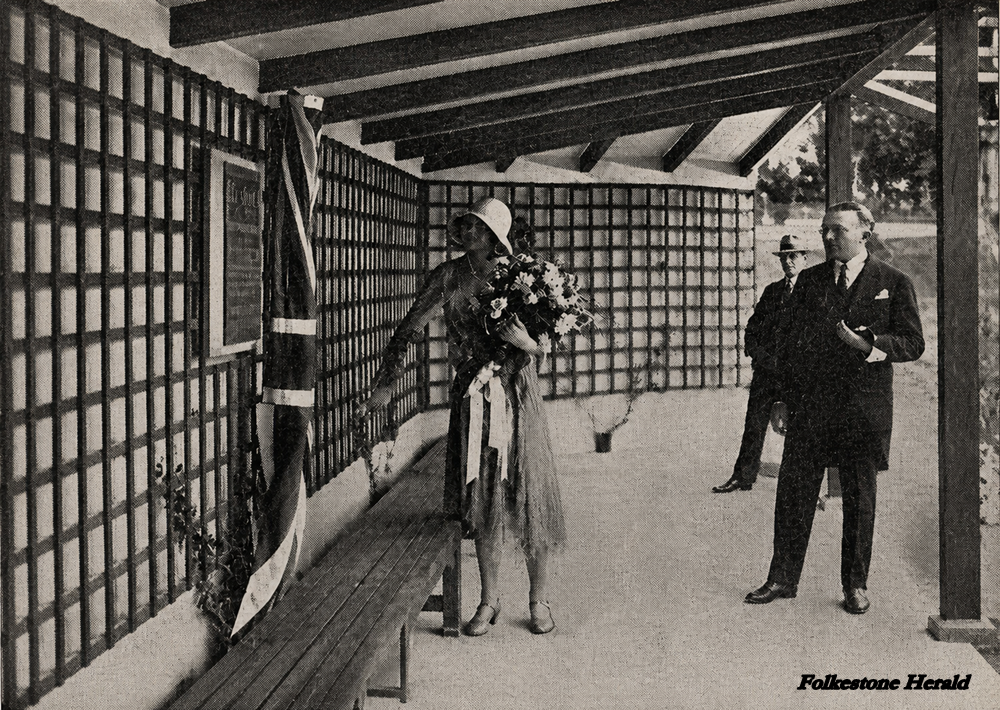
Her Ladyship then unveiled a tablet erected on the wall of the picturesque little shelter which nestles in the bank at the western end of the gardens.
The tablet, covered with the Union Jack, is of bronze and inscribed as follows:—
WOOD, MAYOR
KINGSNORTH GARDENS.
These gardens were declared open to the public by the Viscountess Folkestone in June, 1928, the site having been presented to the town by the Right Honourable the Viscount Folkestone.
G. E. Roden,
Parks Superintendent.
W. H. Moncrieff,
Chairman, Parks Committee.
A. F. Kidson, Town Clerk.
TWO TREES PLANTED.
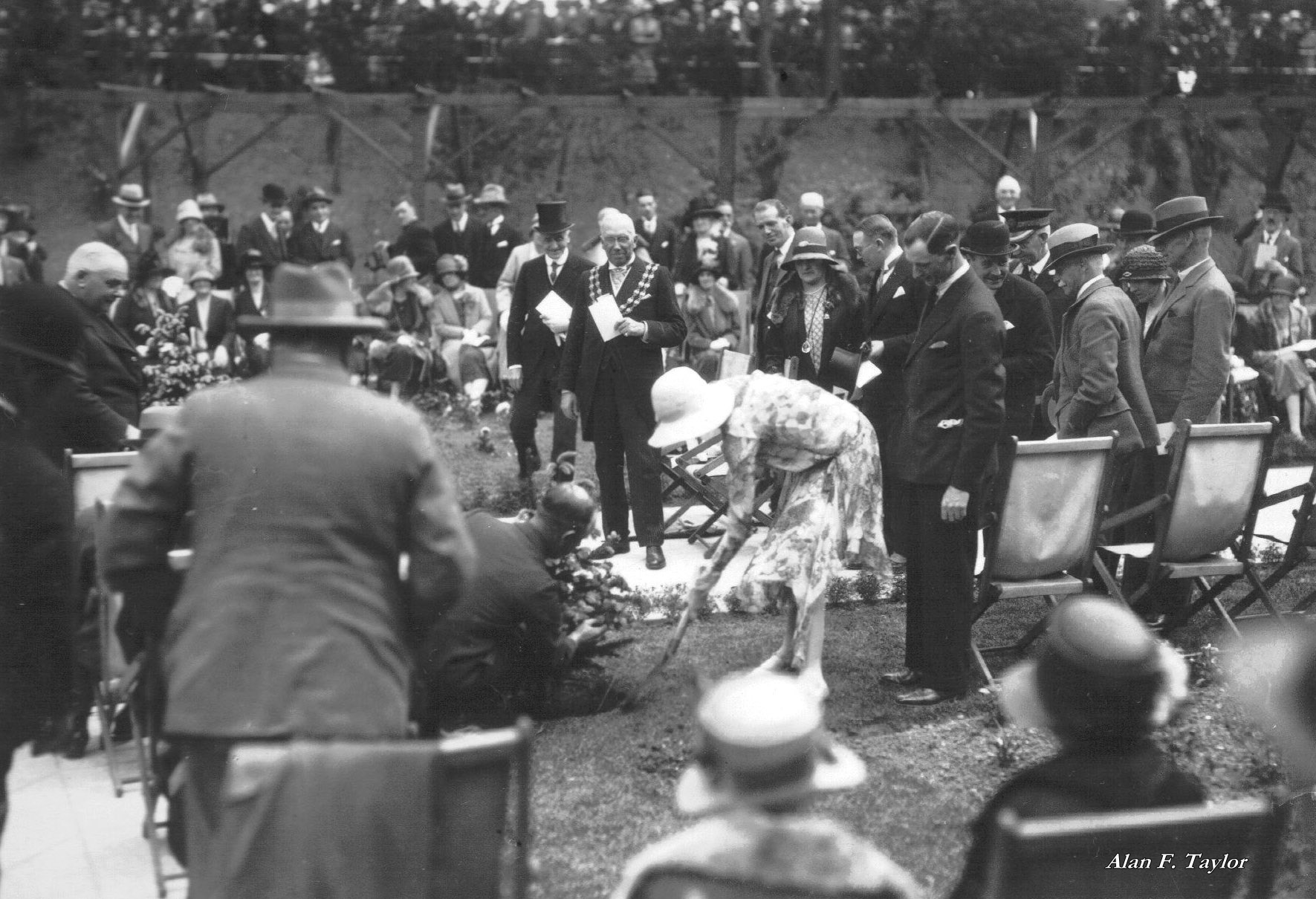
Viscountess Folkestone then planted a tree at the side of the centre path leading from the shelter. After she had thrown several spadefuls of earth round the tree, Viscount Folkestone planted a similar tree on the opposite side of the path.
The trees, similar to Christmas trees, are glaucas.
Alderman Moncrieff said it was his pleasure and privilege to express to Lady Folkestone and Lord Folkestone their thanks and appreciation for their coming amongst them that afternoon and performing so gracefully the ceremony of declaring open those lovely gardens (applause). To one who had some interest in public life the sentence “declare open these gardens to the public” had a charm. To visualise those gardens in the possession of the people of the town for years to come must inspire all those who had an interest in the well being of their town, and it was fitting that the donor of the ground should take such an active part in the opening of the gardens that day (hear, hear).
Surely amongst the greatest benefactors of their kind were the men and women who had had the privilege, the heart and also the courage to bequeath and give open spaces for the enjoyment of the people at all times. (Applause).
It was Oliver Wendell Holmes, he believed, who in one of his novels wrote: “If a man would be truly great he must make a careful selection of his parents.” (Laughter). If Folkestone had had the opportunity in the past of selecting its Lord of the Manor, it could not have made a better choice, he was sure, than the House of Radnor. (Applause).
The Mayor had referred to the many amenities the Estate had given to the town, and those gifts had not only added to the amenities of the borough, but also given great pleasure to the people of the town. With the exception, perhaps, of Radnor Park, he did not believe any of those gifts would be more appreciated than those lovely gardens. (Applause).
He only hoped the conveyance had been well and truly made, otherwise they might have Lord Folkestone wanting the ground back. (Laughter).
They very much appreciated the kindness of Lord and Lady Folkestone in coming in their midst that afternoon. They thanked them again for declaring those gardens open, and they hoped they would see more of them in the future than they had in the past. (Hear, hear).
He did not think their present Mayor dare ask Lord Folkestone for much more (laughter), but there were still one or two things, which they would like as a town, and he intended, when the new Mayor was elected, to whisper into his ear, and he felt sure Lord Folkestone would not refuse. (Laughter).
A SOUVENIR.
Before sitting down, he wanted to ask Lady Folkestone to accept a small souvenir from the Corporation to remind her of the very pleasant afternoon. It took the form of a snuff box and was inscribed with the Folkestone coat of arms and the following words: “Presented to Viscountess Folkestone on the occasion of declaring open Kingsnorth Gardens, Folkestone, and planting a tree in 1928.”
Viscount Folkestone said he could assure the Chairman of the Parks Committee that having seen those gardens, he sincerely wished they had not been well and truly conveyed. (Laughter). He would like to take them back and replace them with his own gardens, which would not look nearly so nice. (Laughter). But knowing the place before those gardens were laid out, he would never have thought it possible to have made such a beautiful spot of it. (Applause).
The gardens were ideally situated, sheltered; in the centre of the town; a place where people could rest in peace and quiet and enjoy the flowers close to the station. And they would undoubtedly attract the attention of visitors as soon as they arrived in the town. Visitors would realise that Folkestone was well worthy of their consideration and a town in which they might very well do much worse than live. (Hear, hear).
A TOWN OF MANY GARDENS.
The gardens would enhance the reputation which Folkestone already has, of being a town of many gardens. These gardens rank high in the gardens of Folkestone—(applause)—and as the years go by and the flowers and trees grow, he believed they would find the Borough Gardener wanting to spend more money on their other gardens and bring them up to the level of this one.
Before he sat down he would like to thank them all for the welcome they had given to his wife and himself that day. It was a real pleasure to come down and see such a brilliant gathering as that and assist in opening such a beauty spot.
He would also like to add his bit of praise to the Borough Gardener who was responsible for the designing of those gardens. It was very easy to go elsewhere and employ an expert, but it cost a great deal of money, and their gardener had done as well, and even better, than many experts who specialised in that kind of thing, and after hearing the kind of labour used, he thought the results achieved were little short of wonderful. (Applause). Congratulations were due to their gardener for what he had done. He would also like to congratulate the Parks Committee, who were primarily responsible, and also the Mayor and Corporation, on the smallness of the cost of the gardens. No doubt they were a great addition to the town of Folkestone, and he was very glad they had decided to do the work, for it meant one more thing which would help to keep the town in its front place amongst other towns along the south coast. (Applause).
Tea was afterwards served on the lawns, and later Lord and Lady Folkestone made a more minute inspection of the Gardens.
The Municipal Orchestra, under Mr. Eldridge Newman, who gave his services, rendered a delightful programme of music during the afternoon.
THE COST AND OTHER DETAILS.
TWO THOUSAND ROSE BUSHES.
The total cost of the work, which was started in December, 1926, was £3,000. At one time the gardens were a brickfield, and the excavation of clay resulted in the present shape. The late Alderman W. Dunk had one of the last local brick kilns made from the clay obtained there.
There are 2,000 rose bushes, representing 18 varieties, all of which are hybrid teas. In the herbaceous border there are about 6,000 plants; and some 500 dwarf dahlias have also been planted.
As one enters from the Central Station entrance one has a magnificent view of the gardens, which cover about five acres. The path slowly dips till one is on the level again, and walking along the centre and main path one comes to a pretty sundial. A little further on the two lily ponds are reached, as well as two delightful little fountains. In the ponds white and pink water lilies add a touch of colour, whilst goldfish can be seen swimming about.
In almost the centre there is a wonderful weeping ash. It was there before the gardens were laid out, and Mr. Roden cleverly managed to retain it. Now in full foliage, it adds a conspicuous dash of rich green to the centre of the grounds.
One walks on, still on the centre path, passing all kinds of beautiful plants, then up a few steps, along another stretch on both sides of which are planted numerous rose bushes now rich in flower, until one finally reaches the little shelter, which is well in keeping with the general beauty of the design. A climber, Cobaea scandens, has been planted to climb the back trellis. This climber has a rich purple flower; and at the back of the shelter there are two or three varieties of ivy whilst a small yellow flower, Tagetes Signata Pumila, adds more colour.
There is also a very good selection of rock plants, whilst the banks are planted with flowering shrubs and standard trees giving coloured foliage. Every plant or shrub in the garden is labelled.
There are four entrances to the gardens, which will be open from 7 a.m. to dusk daily.
The lay-out of the ground is altogether admirable and Mr. Roden is to be warmly congratulated.
OPENING OF KINGSNORTH GARDENS.
Ceremony Performed by Lady Folkestone.
BEAUTY SPOT IN CENTRE OF TOWN.
TRIBUTE TO RADNOR FAMILY’S GENEROSITY
As reported by the Folkestone Herald on Saturday, 28th June, 1928

Wednesday 25th June, 1928
Page updated 10 August, 2026