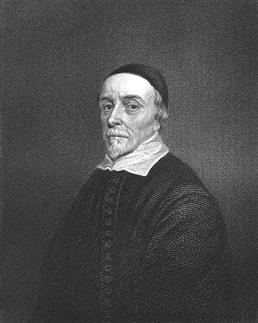
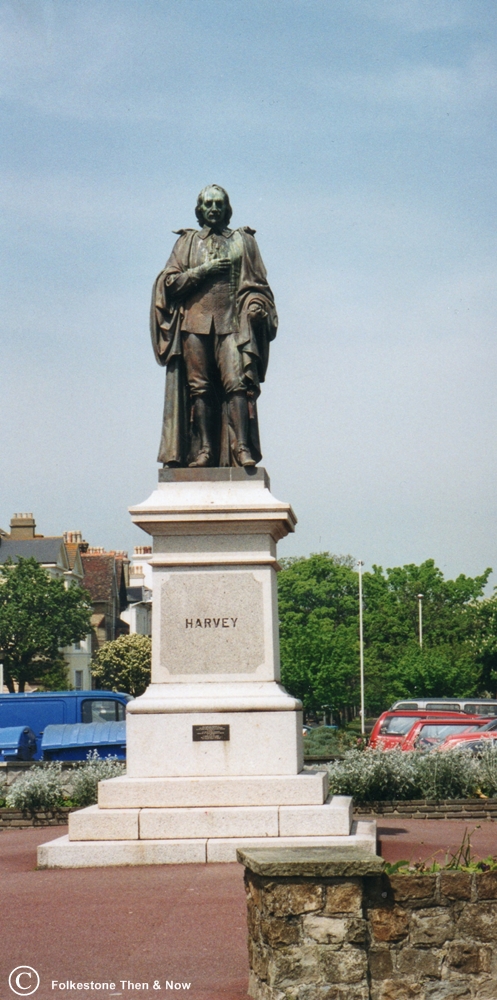
HARVEY, WILLIAM (1578-1657), English physician, the discoverer of the circulation of the blood, was the eldest son of Thomas Harvey, a prosperous Kentish yeoman, and was born at Folkestone on the 1st of April 1578.
After passing through the grammar school of Canterbury, on the 31st of May 1593, having just entered his sixteenth year, he became a pensioner of Cams College, Cambridge, at nineteen he took his B.A. degree, and soon after, having chosen the profession of medicine, he went to study at Padua under H. Fabricius and Julius Casserius.
At the age of twenty-four Harvey became doctor of medicine, in April 1602. Returning to England in the first year of James I., he settled in London; and two years later he married the daughter of Dr Lancelot Browne, who had been physician to Queen Elizabeth. In the same year he became a candidate of the Royal College of Physicians, and was duly admitted a fellow (June 1607).
In 1609 he obtained the reversion of the post of physician to St Bartholomew's hospital. His application was supported by the king himself and by Dr Henry Atkins (1558-1635), the president of the college, and on the death of Dr Wilkinson in the course of the same year he succeeded to the post. He was thrice censor of the college, and in 1615 was appointed Lumleian lecturer.
In 1616 he began his course of lectures, and first brought forward his views upon the movements of the heart and blood. Meantime his practice increased, and he had the lord chancellor, Francis Bacon, and the earl of Arundel among his patients. In 1618 he was appointed physician extraordinary to James I., and on the next vacancy physician in ordinary to his successor.
In 1628, the year of the publication of the Exercitatio anatomica de motu cordis et sasi guinis, he was elected treasurer of the College of Physicians, but at the end of the following year he resigned the office, in order, by command of Charles I., to accompany the young duke of Lennox (James Stuart, afterwards duke of Richmond) on his travels. He appears to have visited Italy, and returned in 1632.
Four years later he accompanied the earl of Arundel on his embassy to the emperor Ferdinand II. He was eager in collecting objects of natural history, sometimes causing the earl anxiety for his safety by his excursions in a country infested by robbers in consequence of the Thirty Years' War. In a letter written on this journey, he says: " By the way we could scarce see a dogg, crow, kite, raven, or any bird, or anything to anatomise; only sum few miserable people, the reliques of the war and the plague, whom famine had made anatomies before I came."
Having returned to his practice in London at the close of the year 1636, he accompanied Charles I. in one of his journeys to Scotland (1639 or 1641). While at Edinburgh he visited the Bass Rock; he minutely describes its abundant population of sea-fowl in his treatise Dc generatione, and incidentally speaks of the account then credited of the solan goose growing on trees as a fable. He was in attendance on the king at the battle of Edgehill (October 1642), where he withdrew under a hedge with the prince of Wales and the duke of York (then boys of twelve and ten years old), "and took out of his pocket a book and read. But he had not-read very long before a bullet of a great gun grazed on the ground near him, which made him remove his station," as he afterwards told John Aubrey. After the indecisive battle, Harvey followed CharlesI. to Oxford, " where," writes the same gossiping narrator, " I first saw him, but was then too young to be acquainted with so great a doctor. I remember he came several times to our college (Trinity) to George Bathurst, B.D. who had a hen to hatch eggs in his chamber, which they opened daily to see the progress and way of generation. " In Oxford he remained three years, and there was some chance of his being superseded in his office at St Bartholomew's hospital, "because he hath withdrawn himself from his charge, and is retired to the party in arms against the Parliament." It was no doubt at this time that his lodgings at Whitehall were searched, and not only the furniture seized but also invaluable manuscripts and anatomical preparations.
While with the king at Oxford he was made warden of Merton College, but a year later, in 1646, that city surrendered to Fairfax, and Harvey returned to London. He was now sixty-eight years old, and, having resigned his appointments and relinquished the cares of practice, lived in learned retirement with one or other of his brothers. It was in his brother Daniel's house at Combe that Dr (afterwards Sir George) Ent, a faithful friend and disciple (1604-1689), visited him in 1650. "I found him," he says. " with a cheeerful and sprightly countenance investigating, like Democritus, the nature of things. Asking if all were well with him-'How can that be,' he replied, 'when the state is so agitated with storms and I myself am yet in the open sea? And indeed, were not my mind solaced by my studies and the recollection of the observations I have formerly made, there is nothing which should make me desirous of a longer continuance.
(source 1911encyclopedia.org)